
Cielcin Language
🌀 Ongoing Project: This wiki is a living archive that’s always growing! Some pages may still be incomplete or in progress. If you’d like to help expand and improve the wiki, we’d love to have you join the discussion on the Red Company Discord. In the meantime, Create an Account (it's free!) and request Contributor Access.
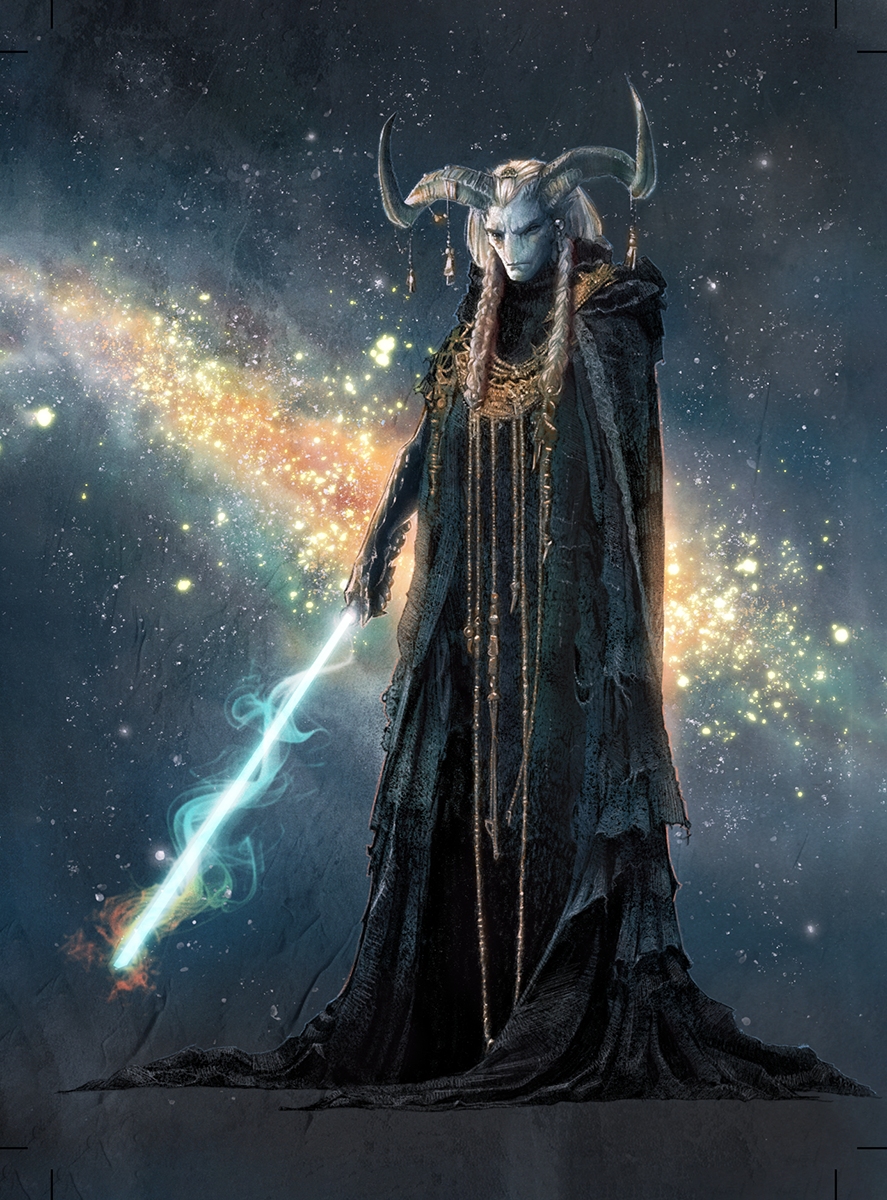
U ti-wetidiu ba-wemuri mnu, wemeto ji.
— A Cielcin religious quotation, meaning, "In the time of dying, we will die."[1]
The language of the Cielcin race, the most advanced known xenobite species, and the only other spacefaring race known aside from humans.
There are many examples of the Cielcin language written in Hadrian Marlowe's accounts, though he does not always provide translations with them, and some of the translations provided are paraphrased. As such, the translations of many words remain unclear.
Full series spoilers below, proceed with caution.
Phonology
Little is known about specific phonology, as the language is known only from written accounts, or as spoken by humans, who are non-native speakers.
One thing known from Lord Marlowe's accounts is that the mn sound present in many Cielcin words is a nasal diagraph, a trilling sound that humans can't produce.[2]
Writing System
The Cielcin written language is called Udaritanu, and is a non-linear glyph form of writing. Individual glyphs are called udaritani. The glyphs are described as interlocking, circular runes, which are pictoral in nature.[3]
Lexicon
Below are listed known Cielcin pronouns, words, titles, and sentences, translated into Classical English. Because of the unreliability of Lord Marlowe's translations, many words and phrases have been excluded from this lexicon if their exact meaning or usage could not be corroborated with other examples provided elsewhere in the accounts.
Some non-spoken communication elements are worth noting. The Cielcin have no word for yes, but instead express affirmative with a hard exhale or outrushing of air. The Cielcin also have a few distinctive gestures to indicate yes or no. Rolling the head in a clockwise motion is akin to a human nod,[1] whereas rolling the head counterclockwise is the equivalent of a human shaking their head. Similarly, tipping the head to the right is a curt affirmative,[4] and assumedly, tipping the head to the left would be a curt negative.
Pronouns
The following table contains personal pronouns, which have three genders: the neuter, the masculine-active, and the feminine-receptive. Because the Cielcin are sexless, genders are not used the same way humans use genders in pronouns. The genders used depend partially on whether the one being referred to is the subject (masculine-active is used) or object (feminine-receptive is used) of the sentence.[6] In cases where the one being referred to is not the object of the sentence but one does not want to project them in the feminine-receptive, the neuter can be used. Gender use can also depend on the social status of the one(s) being referred to. For example, an Aeta is always the subject of the sentence, and thus always uses the masculine-active gender.[7] It is also customary, but not strictly required, for soldiers to be referred to with the masculine-active.[1] However, the genders used can also change based on the situation between the participants of a conversation, with parties in a lower standing using feminine-receptive pronouns.[1] The neuter can be used when there is not a power imbalance.
| Nominative | Accusative | Genitive | Dative | |
|---|---|---|---|---|
| First Person Singular | I | me | my | to me |
| Neuter | koun | o-koun | ba-koun | ti-koun |
| Masculine-active | kousun | o-kousun | ba-kousun | ti-kousun |
| Feminine-receptive | koarin | o-koarin | ba-koarin | ti-koarin |
| First Person Plural | we | us | our | to us |
| Neuter | koun'ta | o-koun'ta | ba-koun'ta | ti-koun'ta |
| Masculine-active | kousun'ta | o-kousun'ta | ba-kousun'ta | ti-kousun'ta |
| Feminine-receptive | koarin'ta | o-koarin'ta | ba-koarin'ta | ti-koarin'ta |
| Second Person Singular | you | you | your | to you |
| Neuter | okun | o-okun | ba-okun | ti-okun |
| Masculine-active | osun | o-osun | ba-osun | ti-osun |
| Feminine-receptive | okarin | o-okarin | ba-okarin | ti-okarin |
| Second Person Plural | you | you | your | to you |
| Neuter | okun'ta | o-okun'ta | ba-okun'ta | ti-okun'ta |
| Masculine-active | ||||
| Feminine-receptive | okarin'ta | o-okarin'ta | ba-okarin'ta | ti-okarin'ta |
| Third Person Singular | it | it | its | to it |
| Neuter | tajun | o-tajun | ba-tajun | ti-tajun |
| Masculine-active | ||||
| Feminine-receptive | tajarin | o-tajarin | ba-tajarin | ti-tajarin |
| Third Person Plural | they | them | their | to them |
| Neuter | tajun'ta | o-tajun'ta | ba-tajun'ta | ti-tajun'ta |
| Masculine-active | ||||
| Feminine-receptive | tajarin'ta | o-tajarin'ta | ba-tajarin'ta | ti-tajarin'ta |
Dictionary
The following dictionary was developed by comparing entries in a collected database of Cielcin dialogue and terms provided in Lord Marlowe's accounts. In some cases, a translation provided in text seemed likely enough given its context to trust as accurate. In many other cases, words are only included in this dictionary if the same word, or at least word base, was used in multiple places and the majority of those instances had the same meaning attibuted to them.
Nouns are provided with plurals denoted if the plural was mentioned in the texts, and otherwise only include the singular forms. Verbs are provided in two potential forms: the infinitive (base form), if available, and the imperative (command form, denoted as such in each instance), which is very commonly used. Many verbs deciphered were only available in command form, thus their inclusion in this dictionary. Many other verbs have been desiphered in one or more tenses, but because of the large variation in the availability of these forms, verbs for which the base form and/or command form weren't identifiabe are not included here, with the exception of certain forms of the verb to be because of their commonality in usage.
Command forms of verbs are consistent in always ending in -a or -aa, and in some cases, both versions have been seen for the same verb. It is possible that a single -a is the standard version, and -aa is used when the word is meant to be emphasized, but this is just theory and has not yet been confirmed.
| Cielcin | Classical English | Notes | Part of Speech |
|---|---|---|---|
| abassa | father | noun | |
| adajjaa (command form) | restrain | verb | |
| adiqqa (command form) | fight / battle | verb | |
| aeta / (pl) aetane | prince | noun | |
| Aeta-Shiomu | Lord-Prophet | noun | |
| aetavanni | A meeting of the Aeta | noun | |
| akaranta | The dominmant cieclin sexual role | noun | |
| akatha | because | conjunction | |
| akute | shrine | noun | |
| alatayu | nemesis / destroyer | noun | |
| anabitimyr | might-right | As in an individual's right to something based on earning it via might; as opposed to blood-right | noun |
| anasaka | serpent | noun | |
| asvatiri | give | verb | |
| attantar | blessed | adjective | |
| baetan / (pl) baetayan | priest-historian | Also means root | noun |
| balatiri | pray | verb | |
| begu | how | adverb | |
| beletarin | masters | noun | |
| belnna (command form) | give / return | verb | |
| belu | one (not numerical) | pronoun | |
| biqari / biqqa (command form) | kill | verb | |
| biqarin | killer | noun | |
| ca | well | adverb | |
| caenuri | heal | verb | |
| caihanarin | the watchers / the gods | noun | |
| caiharu | faith | noun | |
| cara | much | adverb | |
| caradiu | gift | noun | |
| Cielcin | The People | proper noun | |
| civaqari / civaqa (command form) | come | verb | |
| cotelie | emmisary | noun | |
| coteliho | herald | noun | |
| daktaru | mercy / clemency | noun | |
| daqami | need | verb | |
| darathar | alive | adjective | |
| daratiri | live | verb | |
| datorete | proof | noun | |
| dazen | how | adverb | |
| dein | what | interrogative pronoun | |
| denam | twice | adverb | |
| deni | who | interrogative pronoun | |
| detu | why | adverb | |
| Dhar-Iagon | The fortress-palace in Dharan-Tun | proper noun | |
| Dharan-Tun | Syriani Dorayaica's worldship | proper noun | |
| diyugatsau | free | adjective | |
| dunyasu | abomination / accursed / blasphemy | noun/adjective | |
| eija | up | preposition | |
| eijana | above | Used to refer to the Irchtani, because Cielcin have no other word for them | adverb/noun |
| eja-ayan / ejaan | nothing | noun | |
| eka | (I) am | verb | |
| elusha | king | noun | |
| ennallaa (command form) | leave / depart | verb | |
| eza | and | conjunction | |
| fusu'un | world | noun | |
| Fusumnu | a dark world | noun | |
| gasvaa/gasvva (command form) | kneel | Both spellings have been seen | verb |
| genanarin | the makers | noun | |
| gennuthar | impossible | adjective | |
| gin | by | preposition | |
| hasimnka | The status of Cielcin who have no station, do not belong to anyone, or own no-one. Considered unclean | noun | |
| heiyui | stupid | adjective | |
| hurati | Cielcin equivalent to a mouse | noun | |
| Iazyr Kulah | The True World / Paradise | A religious concept; a universe of pure thought or spirit which is obscured by the material universe | proper noun |
| ichakta | captain | noun | |
| idate | over (done, finished) | adjective | |
| iedyr / (pl) iedyya | hand | noun | |
| Iedyr Yemani | White Hand | The six vayadan generals that serve Syriani Dorayaica | proper noun |
| iedyrn | handed | adjective | |
| ietta (command form) | submit | verb | |
| ietumna | inferior; the submissive cielcin sexual role | noun | |
| ijanammaa (command form) | hold | verb | |
| ikuchem | injured | adjective | |
| ikurra | blood | noun | |
| ikurratimyr | blood-right | noun | |
| ina | or | conjunction | |
| ioman | more | adjective | |
| irinyr | silk | The byproduct of a many-legged, aquatic, bottom-feeding worm | noun |
| itani / (pl) itanimn | family group / clan / tribe; constellation | verb | |
| iugannan | liar | noun | |
| iukatta (command form) | stop | verb | |
| iya | two | ||
| iyadar | slave | noun | |
| Izhkurrah | Blood | An archaic form of the word with religious meaning | noun |
| jishiara | a creature that sheds its skin | noun | |
| junne | down | verb | |
| kajadi / (pl) kajadimn | slave | verb | |
| kalupanari | cielcin chimera warriors | noun | |
| kasamnte | nothing | noun | |
| kavaa | hello | interjection | |
| keta | close (as in near) | adjective | |
| kianuri / kianna (command form) | run | verb | |
| lenna (command form) | stay | verb | |
| lumare | many | adjective | |
| marerra (command form) | tell | verb | |
| Miudanar | The Dreamer | One of the Watchers | proper noun |
| mnu | When following a verb, effectively adds "ing" | present participle | |
| mnunatari / (pl) mnunatarimn | merchant / scavenger | A caste considered pariahs | noun |
| morossa (command form) | name | verb | |
| naddimn | insane | adjective | |
| nahute | A Cielcin weapon that resembles a flying metal snake, and seaks out targets and drills into them | noun | |
| namshun | name | noun | |
| ndaktu | death-mercy | Mercy/judgement/justice; a formal mercy and moral responsibility to end the suffering of an individual who one has led to suffer | noun |
| netotta (command form) | answer | verb | |
| o-peryuete | nowhere | noun | |
| odein | property | noun | |
| oimn | dark | adjective | |
| ondathanyu | untouched | adjective | |
| onnanna (command form) | to be quiet | verb | |
| oretiri | see | verb | |
| oscianduru | worldships | noun | |
| ouluu | soul / spark | noun | |
| oyumn | that | pronoun/conjunction | |
| panathidu | medicine | noun | |
| paqqaa (command form) | eat | verb | |
| psaqattaa (command form) | choose | verb | |
| qiati | utility | In Cielcin culture, an individual's usefulness or worth to its owner | noun |
| qilete | peace / submission | noun | |
| rajithiri | trade | verb | |
| raka | (it) is | verb | |
| retattaa (command form) | look | verb | |
| rumumn | skull | noun | |
| saryr | far | adjective | |
| scahari / (pl) scaharimn | soldier` | One of the warrior caste | noun |
| scianda / (pl) sciandane | fleet | noun | |
| Se Vattayu | Earth | The Cielcin homeworld | proper noun |
| sha | from | preposition | |
| shi | for | preposition | |
| Shiomu | The Prophet | noun | |
| shuindu | guard | noun | |
| siabbaa (command form) | behold | verb | |
| sikarra (command form) | confess | verb | |
| sim | not | When not accompanied by a verb; see -yu for use with verbs | adverb |
| sosulan | Some sort of swear word | interjection | |
| su | so | adverb | |
| sulan | a creature that once hunted Cielcin | noun | |
| susulatari (pl) | monsters / devils | noun | |
| svassaa (command form) | surrender | verb | |
| tagasvate | sport | noun | |
| ti-perem | where | adverb | |
| ti-saem gi | here | adverb | |
| ti-wetidiu | now | adverb | |
| tiatari | worker | Specifically, of the worker caste | noun |
| tuka | (you) are | verb | |
| tutai | good | adjective | |
| tutaihete | generous | adjective | |
| u | one | noun | |
| uatanyya (pl) | branchings | noun | |
| uavn | fruit | noun | |
| ubbaa (command form) | listen | verb | |
| ubimnde | eleven | noun | |
| udantha | today | noun | |
| udaritani | The glyphs of the Cielcin written language | noun | |
| Udaritanu | The non-linear, glyph written language of the Cielcin | noun | |
| udata | fine | adjective | |
| ude | four | noun | |
| udeo | back | adverb | |
| udim | first | adjective | |
| uelacyr | time | noun | |
| uganatai | emperor | noun | |
| Uiddaa (command form) | throw | verb | |
| uja | but | conjunction | |
| ujazayu | the substance | Pertaining to the body, as opposed to the soul | noun |
| uje | and | conjunction | |
| unassa | alone | adjective | |
| unjasan | meat | noun | |
| usayu | only / just | adverb | |
| ushan | beloved / prized | adjective | |
| Utannash | The Deceiver / That-which-lies | The Cielcin name for the Quiet | proper noun |
| Utannashimn | followers of Utannash The Deceiver | Literally, the plural of Utannash | proper noun |
| ute | The / true / great | This doesn't translate easily into Classical English, but serves to add importance to the word it preceeds | adjective |
| utorie | command | noun | |
| uvattaya | child | Has roots in fruit and body | noun |
| vaa | with | preposition | |
| vaayu | without | preposition | |
| vandate | strength | noun | |
| vatate | body | noun | |
| Vayadan | general / holy slave | Sworn protector of a Cielcin Aeta, his last line of defense, his closest councilor, and his concubine | noun |
| veih | no | adverb | |
| velatate | ship | noun | |
| velegamaya (pl) | asteroids | noun | |
| velenamuri / velenamma (command form) | take | verb | |
| vohosum | between (the stars) | adjective | |
| wegga (command form) | walk | verb | |
| wemathar | dead | adjective | |
| wemayu | death | noun | |
| wo | Emphasizes what it accompanies | ||
| yelnuri / yelna (command form) | come | verb | |
| yu | A suffix, that when attached to the end of a verb, makes it negative | adverb | |
| yukajji /(pl) yukajjimn | human / vermin | noun | |
| yumna | this | pronoun/adjective | |
| zadituri | pilgrimage | noun |
Sentences
This table consists of a collection of Cielcin phrases for which the translations are reasonably well assured. Many other pieces of Cielcin dialogue from Lord Marlowe's texts are accompanied by apparent translations, but not all of them are able to be confirmed. In some cases, some words are desipherable and they do not match what Lord Marlowe claims they translate to, indicating unreliability of the translation given as a whole. There are phrases not included in this table for which it is possible Lord Marlowe gives accurate translations, but for the sake of accuracy, they are excluded if the meaning of any part of the phrase could not be confirmed by comparing words and word bases to other phrases in his texts.
| Cielcin | Classical English | Notes |
|---|---|---|
| Adiqursa ti-caihanaru vaa wo! | You battled the god! | |
| Aeta ba-Aetane | Prince of Princes | |
| Aeta ba-itanimn. | Prince of the clans. | |
| Aeta ba-Yukajjimn | The King of Vermin | |
| Aeta eza dunyasu. | Aeta and abomination. | |
| Aeta yelnun wo. | The prince comes. | |
| Akute ba-rumumn | The Shrine of the Skull | |
| Ba-Aeta-doh, daratolo! | my Aeta, you live! | |
| Balatiri! Civaqatto balatiri! | Pray! We came to pray! | |
| Belnna uvattaya ba-kousun ti-koarin! | Give me back my child! | |
| Belutoyu o-tajarin'ta. | I do not know them. | |
| Biqqa totajun, Vayadan-do! | Kill them all, Vayadan! | |
| Biqqaa! Biqqaa totajun wo! | Kill them all! | |
| Biqunna o-tajarin'ta wo! | We will kill them! | |
| Caiharu ba-okun. | Your faith. | |
| Cielcin ba-kousun. | My Cielcin. | |
| Cielucin ba-koun! | My People! | |
| Citharathun mnu. | She's translating. | |
| Daktaru ina ndaktu, ba-Aeta-doh! | Clemency or death-mercy, my Aeta! | |
| Dein belutono ba-Caihanarin ne? | What do you know about The Watchers? | |
| Dein mareru ne? | What did you say? | |
| Dein raka ne? | What is it? | |
| Dein tuka okun ne? | What are you? | |
| Deni raka Aeta ba-okun ne? | Who is your prince? | |
| Detu adiqamam ne? | Why fight? | |
| Eka ba-osun. | I am yours. | |
| Eka iyadar ba-osun. | I am your slave. | |
| Eka Kharn Sagara. | I am Kharn Sagara. | |
| Eka ti-perem gi ne? | Where am I? | |
| Eka ti-saem gi! | Here I am! | |
| Eka udata! | I'm fine! | |
| Ekanyi yukajjimn. | We are men/vermin. | |
| Elusha ba-Cielcin. | King of the Cielcin. | |
| Elusha ba-Izhkurrah! | King of the Blood! | |
| Elusha ba-koarin. | My king. | |
| Ennallaa o-ajun. | Leave us. | |
| Iagamni mnu ti-perem ne? | Where are we going? | |
| Iagga, Tanaran-kih! Iagga! | Go, Tanaran! Go! | |
| Iedyr Yemani | White Hand | |
| Ijanammaa o-tajun junne wo! | Hold him down! | |
| Ikurra pa ba-ikurra! | Blood for blood! | |
| Iubalu-kih rakunyu ba-okun biqari. | Iubalu was not yours to kill. | |
| Iyadar ba-kousun ne? | My slave? | |
| Kianuri mnu ne? | Running? | |
| Lenna udeo. | Stay back. | |
| Marerose o-kun. | I told you. | |
| Marerra o-tajun civaqari eza velenamuri ti-koun! | Tell it to come and take me! | |
| Marerra ti-koarin! | Tell me that! | |
| Morossa okun-kih! | Name yourself! | |
| Nasca nietiri. | I want to talk. | |
| Netotta ti-koun! | Answer me! | |
| Nietamda, Ichakta-doh! | It spoke, captain! | |
| Nietiri mnu dein ne? | Saying what? | Literal translation. Effectively means "what is he/it saying?" |
| Nietolo dazen ne: "eatabareto o-velegamaya"? | How do you say "we hollowed out asteroids"? | |
| Numeu ti-Shiomu, yukajji! | You belong to the Prophet, vermin! | |
| Oimn Belu | The Dark One | A title of Hadrian Marlowe |
| Okun detu ne? | Why you? | |
| Okun-kih. Iagga. | You. Go. | |
| Okun'ta naddimn. | You are insane. | |
| Oreto o-yukajji wo! | I see humans! | |
| Qulleti asvatiri o-cotelie ti-okarin. | We wish to give you an emissary. | |
| Raka Aeta Aranata ti-perem gi ne? | Where is prince Aranata? | |
| Raka attantar Aeta ba-ajun! Ute Iedyrin Yemani Iugannan-Biqarin! | Blessed be our clan-chief! The white-handed godkiller! | |
| Raka attantar Ute Aeta ba-Aetane ba-Eue! | Blessed be the prince of the princes of Eue! | |
| Raka ba-Utannash. | They are of the Lie. | Hadrian's attempt to say "they are lying." |
| Raka deni ne? | Who is this? | |
| Raka ichaktan. | This is the captain. | |
| Raka kasamnte. | It's nothing. | |
| Raka namshun ba-koun Hadrian. | My name is Hadrian. | |
| Raka oyumn Aeta Ugin Attavaisa. | That is Aeta Ugin Attavaisa. | |
| Raka Tanaran ti-saem gi ne? | Is Tanaran here? | |
| Raka ti-saem gi! | Here it is! | |
| Raka tutaihete. | That is generous. | |
| Raka unjasan. | It is meat. | |
| Raka ute uelacyr. | It is the time. | |
| Raka vaa ti-yukajjimn. | With the humans. | |
| Rakasuryu ti-saem gi. | They are not here. | |
| Rakayu abassa ba-okarin ti-saem gi. | Your father isn't here. | |
| Rakur oyumn heiyui. | That was stupid. | |
| Shiabbaa! Ute Aeta ba-Yukajjimn! | Behold! The King of Men! | |
| Shiomu iunane o-okun darathar. | The Prophet wants you alive. | |
| Siajenu iagari o-peryuete, akatha. | Because you have nowhere to go. | |
| Siajenu ti-saem yu kianuri! | You have nowhere to run! | |
| Sim ca. | Not well. | |
| Sim lumare. | Not many. | |
| Sim saryr. | Not far. | |
| Sim udantha. | Not today. | |
| Sim unassa. | Not alone. | |
| Tuka namshun ba-okun ne? | What is your name? | |
| Tuka okarin ikuchem. | You are injured. | |
| Tuka okarin'ta ba-kousun. | You are mine. | |
| Tuka okun-se belu ba-Iedyr Yemani ne? | Are you one of the white hand? | |
| Tuka okun-se belu wo. | You are the one. | |
| Tuka udata ne? | Are you fine? | |
| Tuka yukajjimn! Tuka eja-ayan! | You are Vermin! You are nothing! | |
| Tuka... devil ne? | Are you... the devil? | |
| Tuka'ta detu ti-saem gi ne? | Why are you here? | |
| Tutai wo. Velenamma o-ajun junne, Vayadan-kih. | Very good. Take us down, General. | |
| Uboretata ioman ti-belu sha ba-aetane. | I expected more from one of your aeta. | |
| Ububonoyu o-okun-do. | They cannot hear you. | |
| Uja raka Aeta wo! | But it is Aeta! | |
| Uje ekau. | And I will. | |
| Uje ekurimi su keta. | And we were so close. | |
| Usayu okun. | Just you. | |
| Usayu u! | Only one! | |
| Ushan belu | Beloved/prized one | |
| Ute Aeta ba-Yukajjimn. | The true King of Man. | |
| Ute Dunyasu | The Great Affront | |
| Vati-kih, yelnna. | Vati, come. | |
| Vayadan ba-Shiomu | Holy slave of the Prophet | |
| Veih ioman! | No more! | |
| Velenamma o-Nobuta ti-veletate, Oalicomn-do. | Take Nobuta to the ship, Oalicomn. | |
| Wananbe o-caradiu ti-Aeta ba-okarin shi, Kajadi-se! | I have prepared a gift for your master, slave! | |
| Wegga ush ti-koun. | Walk with me. | |
| Wemayu udim! | Death first! | |
| Weme uja. | But I'll die. | |
| Yelbe odein ba-kousun shi. | I have come for my property. | |
| Yuramyu o-koarin. | It wasn't me. |
Trivia
- The grammar structure of the Cielcin language is inspired by both Latin and Japanese.[5]
See Also
- Links to other articles that relate to the language, in a list.
- Only link pages that don't appear frequently in the text above.
No comments to display
No comments to display